
Pole Vault Pole Flex Rating Guide: Precision Engineering for Elite Performance
Vault Pole Flex Rating Guide: Precision Engineering for Elite Performance
Your weight rating is a
safety floor, but your flex number is your performance ceiling. You’ve felt hesitation
at the back of the runway. You’re staring at a new pole from a different brand,
wondering if the flex number translates to your current progression. Confusion
over non-standardized metrics leads to inconsistent transitions. It creates a
legitimate fear of blowing through a pole during a PR attempt. In this sport,
precision is the only path to security.
This pole vault pole flex rating guide
provides the technical clarity you need to master these nuances. You’ll learn
to execute seamless transitions and maximize your vertical potential by
understanding the engineering behind the bend. We’ll break down the math of
stiffness, establish a repeatable system for your pole bag, and give you the
confidence to choose gear that supports your ambitions. It’s time to turn
technical confusion into a disciplined competitive advantage.
Key Takeaways
-
Decode the
three critical identifiers-length, weight rating, and flex-to precisely
control your vault’s arc and grip height. -
Utilize
this pole vault
pole flex rating guide to understand the science of
stiffness and how standardized 50lb weight tests dictate pole behavior. -
Apply the
0.2 Rule to manage transitions between weight classes, effectively
bridging the gap between standard 5lb increments. -
Eliminate
the fear of blowing through poles by mastering the math behind flex
numbers and their direct impact on vertical potential. -
Leverage
FiberSport’s precision engineering and tight flex tolerances to ensure
every transition in your series is predictable and high-performing.
Table of Contents
FiberSport has a system where you can adjust the flex numbers
Anatomy of a Vaulting Pole: Decoding the Three Numbers
Every competition pole is
defined by three distinct numbers etched into its surface. These aren’t just
labels; they are the engineering DNA of your vault. Length, weight rating, and
flex work together to dictate how much energy the pole can store and
return. While the history of
pole vaulting shows a transition from bamboo to modern carbon fiber, the
fundamental physics of leverage remains constant. Length determines your
potential grip height and the radius of your arc. A longer pole allows for a
higher handhold, but it requires more speed to move to vertical. The
interaction of these three metrics determines the placement and resistance of
the sail piece.
The weight rating serves as
your safety baseline. For the 2026 season, NFHS regulations mandate that a
competitor’s weight must be at or below the manufacturer’s rating. This rating
is typically marked in a contrasting color at least 3/4 inch high. However, the
weight rating is often a rounded increment. Flex is the granular measurement of
stiffness, recorded in millimeters or centimeters. It is the most precise tool
in this pole vault pole flex rating guide for fine-tuning your equipment progression.
Precision matters. Performance follows.
Why Weight Rating Isn’t Enough
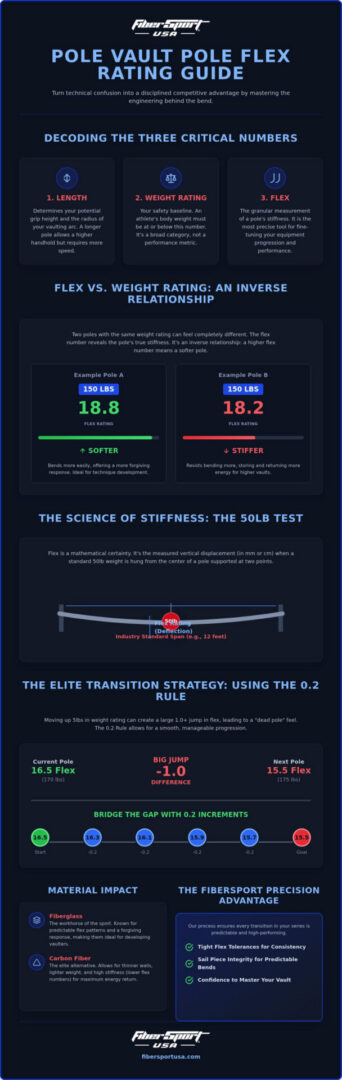
Standard weight ratings are
broad categories. You might have two poles both labeled 150lbs, but they won’t
feel identical. One might have a flex of 18.2 while the other sits at 18.8. The
higher the flex number, the softer the pole. Relying solely on weight ratings
leads to the "dead pole" feel. This happens when a vaulter moves to a
stiffer pole that doesn’t provide the expected energy return. Flex provides the
raw engineering data needed to bridge these gaps. Much like how a developer
uses it to pinpoint specific values within complex data structures,
understanding flex ratings allows you to identify the exact pole needed for
your progression. It ensures your transitions are based on engineered physics, not
guesswork.
EXAMPLE:
A 14’1"-155 pole might have a flex of 19.7 (Mid-Flex) at the FLEX Grip. Moving the grip up, 3 fingers will soften the pole by .3 to 20.0 (Soft Flex). Moving the grip down 4 fingers from the FLEX Grip stiffens the pole by .4, making it a 19.5 (Stiff Flex). The timing is very specific on our poles & will vary by increases and decreases of the grip by fingers (Not inches or a fist). This method is better than buying a series of poles with .2 to .4 flex ranges; just adjust the pole you are on. One may adjust a pole a max of 6 fingers up or down without hindering the pole bend curvature arc.
The Role of the Sail Piece
The sail piece is the
structural heart of the pole. It is the reinforced, thickest section where the
bend is centered during the maximum load phase. Flex ratings specifically
reflect how this reinforcement resists deformation. If the sail piece is inconsistent,
the pole will "hinge" or collapse prematurely. FiberSport Pole
manufacturing focuses on sail piece integrity to ensure a predictable response.
Our process maintains tight tolerances across an entire series. FiberSport positions the sail to meet the needs of those who swing slow, medium, and fast; this is all relative to how the pole bend curvature will work with the jumper! This consistency allows athletes to select a style of pole HC, USA, or PRO that fits their timing, allowing them to drive into the box with absolute confidence in their equipment’s structural response. What happens after the plant is a result of resistance, flex number, and how the pole bends!
How Flex Ratings are Measured: The Science of Stiffness
Flex is a mathematical
certainty, not a marketing label. It represents a physical response to a
controlled load. To generate the data found in this pole vault pole flex rating guide,
manufacturers utilize a static deflection test. The pole is placed on two fixed
supports, typically set 12 feet apart. A 50lb (22.7kg) weight is then suspended
from the exact center of the pole. The measurement of how far the pole dips
under this weight becomes the flex rating. It’s a transparent look at the
structural integrity of the equipment before it ever reaches the runway.
The relationship between the
number and the feel is inverse. A lower flex number indicates a stiffer pole
because it resisted the 50lb weight more effectively. A higher flex number
means the pole dipped further, signifying a softer, more pliable response. If
you’re moving from a 20.5 flex to a 19.5 flex, you’re moving to a more rigid
instrument. This precision allows vaulters to quantify the exact resistance
they’ll encounter during the plant and take-off phases. Understanding the dynamics of the pole vault click to get a free copy of The Elusive Bar II. wrtiteen by Bruce Caldwell.
The Industry Standard Span Test
The 12-foot span is the
typical benchmark for industry, but it isn’t a universal law. Some
manufacturers use metric spans or slightly different support distances. This
variation creates "number drift." It’s the reason why a 15.0 flex
from one brand feels different than a 15.0 from another. Deflection is defined
as the vertical displacement under a static load. When the span changes, the
displacement changes. To maintain consistent progression, you must know the
testing span of your equipment. For athletes demanding absolute consistency
across their series, choosing FiberSport
USA ensures your gear meets these rigorous, repeatable engineering
standards.
Material Impact: Carbon vs. Fiberglass
Materials dictate the
behavior of the bend. Fiberglass poles are the workhorses of the sport. They
generally show more predictable flex patterns, making them ideal for developing
vaulters who need a forgiving response. Carbon fiber is the elite alternative.
It allows for thinner walls while maintaining high stiffness and lower flex
numbers. This reduces the pole’s weight without sacrificing power. FiberSport HC, USA, and Pro Styles utilize advanced composites to maintain flex integrity over time. This
engineering prevents the "softening" that occurs in inferior poles
after repeated high-stress cycles. You get a pole that performs the same on the
thousandth jump as it did on the first.
Flex vs. Weight
Rating: Navigating the Transition
Weight ratings are safety
benchmarks. They represent the maximum load capacity at the top hand-hold
position. However, elite performance lives in the nuances between these
five-pound increments. Using this pole vault pole flex rating guide as your blueprint allows you to
bridge the gap between standard weight classes. It transforms your equipment
from a random collection of tools into a precision-engineered series. Weight is
the floor; flex is the ceiling. Mastering the interaction between the two is
how you execute seamless transitions during a high-stakes competition.
Flex numbers often reveal
overlaps that weight ratings hide. For example, a "soft" 160lb pole
with a higher flex number may respond almost identically to a "stiff"
155lb pole with a lower flex number. This overlap is a strategic asset. It
allows coaches to find "in-between" poles for athletes who are
progressing but aren’t quite ready for a full five-pound jump. FiberSport Poles
are specifically engineered for linear transitions. We prioritize consistent
flex-to-weight ratios to remove the guesswork from your progression. You drive
into the box knowing exactly how the pole will react.
The NFHS Weight Rule Reality
For the 2026 season, NFHS
compliance remains absolute. Vaulters must use a pole rated at or above their
actual body weight. This rule is a critical safeguard. However, a legal pole
isn’t always the right pole. A light vaulter might struggle to move a "stiff"
pole in their weight class. By analyzing flex, you can identify the
"easiest" legal pole. This is the pole with the highest flex number
within your required weight rating. Be cautious. There is a danger in
over-bending a high-flex pole. Even if the weight rating is legal, an athlete
with extreme speed can exceed the structural limits of a soft pole. Safety and
performance must remain in balance.
Grip
Height and Effective Stiffness
Your hand position changes
the physics of the lever. Lowering your grip by 3 to 6 inches effectively
stiffens the pole. This simulates a lower flex number without switching
equipment. A common rule of thumb in the sport is that moving down three inches
on the pole adds roughly five pounds of effective resistance. The
"effective weight" increases as you move up the pole and decreases as
you move down. Precise flex numbers are required for calculating these safe
grip adjustments. Without them, you’re guessing at the structural response.
FiberSport provides the data density needed to make these tactical calls with
absolute confidence. Precision in the air begins with precision on the ground.
The Elite Transition Strategy: Using the 0.2 Rule
Moving up in a pole series
usually involves a change in length or a five-pound weight jump. These are
significant shifts. For an athlete at the peak of their progression, a
five-pound jump can feel like hitting a wall. The 0.2 rule provides the
precision needed to bridge this gap. This pole vault pole flex rating guide identifies
that a 0.2 change in flex is often equivalent to a 2 to 3lb change in
stiffness. It’s the "half-step" that allows for continuous momentum
without compromising safety or technique.
Strategic transitions are
built on these small increments. Moving from a 15.2 flex to a 15.0 flex on the
same length pole is a calculated tactical move. It increases resistance just
enough to handle a faster approach without requiring a complete overhaul of
your plant timing. FiberSport recommends maintaining a consistent flex gap
across your entire series. This consistency ensures that every pole in your bag
feels like a logical progression of the last. You don’t just jump; you evolve.
Step-by-Step
Transition Protocol
Execution on meet day
requires a disciplined protocol. Follow these steps to manage your series with
absolute confidence:
-
Identify
the blow-through point: Recognize when your current
pole is over-bending and failing to provide vertical lift. This is your
signal to move up. -
Compare
flex numbers: Select the next pole in your
series. Aim for a flex that is 0.2 to 0.4 stiffer (lower number) than your
current equipment. -
Adjust
grip height: Lower your top hand by 1 to 2
inches for the first jump on the new pole. This compensates for the
initial stiffness until you adjust to the new timing.
Managing
a Multi-Brand Bag
Precision is lost when you
mix manufacturers. You cannot trust a 15.0 flex from Brand A to match a 15.0
from Brand B. Discrepancies in testing spans and mandrel designs create
"number drift," which can lead to dangerous stalls or unexpected breaks.
The safest strategy is to index your poles to a single master brand. FiberSport
provides the industry standard for consistent flex-to-weight ratios. If you are
building your first series, start with our guide on how to choose a pole vault pole to
establish a professional foundation. High-performance vaulting leaves no room
for brand-to-brand guesswork. Stick to a single engineering standard to protect
your PR attempts.
Maximizing
Performance with FiberSport Precision
FiberSport Poles represent
the apex of precision engineering. We design for the high stakes of elite
competition. Every FiberSport Pole is a critical safeguard for your vertical
ambitions. Our manufacturing protocols ensure the tightest flex tolerances in
the industry. This level of control eliminates the uncertainty found in
mass-produced alternatives. You get a predictable response. You get a reliable
partner. Using this pole
vault pole flex rating guide allows you to leverage our
engineering for your specific progression. Precision on the ground translates
to height in the air.
Performance is built on
trust. You must know that your equipment will respond identically jump after
jump. FiberSport USA manufactures high-performance poles that prioritize this
consistency. We don’t just meet industry standards; we set them. Our national
dealer network provides expert equipment support to ensure your program selects
the correct flex for every vaulter in your series. We understand the physical
demands placed on gear. Our engineering focus emphasizes durability and athlete
safety above all else.
The
FiberSport Advantage
Consistency is the benchmark
of our process. We ensure precise sail piece placement across every series.
This creates a predictable energy return during the most critical phase of the
vault. Our rugged construction maintains original flex ratings over hundreds of
high-stress cycles. Inferior materials soften. FiberSport endures. This
structural integrity empowers athletes to drive into the box and clear higher
bars with total confidence. It’s the difference between a generic tool and a
professional instrument. You gain the security of knowing your pole won’t
"give out" when you’re attacking a new PR.
Equipping
Your Program
Coaches require a system.
They don’t just need a set of tools. FiberSport USA provides customized flex
series tailored to the specific needs of your roster. We offer bulk ordering
options for schools and clubs seeking to standardize their equipment bags. This
ensures that every athlete has access to the 0.2 flex increments required for
elite transitions. Protecting this investment is mission-critical. Utilize
FiberSport Pole Vault Cases and RockBack Bags to shield your high-flex assets
during travel. Precision on the runway requires protection on the road. Don’t
leave your performance to chance. Explore
the FiberSport Pole Collection to build your elite series today.
Master Your Vertical Progression
Precision is the difference
between a stalled vault and a new personal record. This pole vault pole flex rating guide
has provided the technical shift from broad weight ratings to the granular data
of flex numbers. You now understand how the 50lb deflection test dictates pole
behavior and how the 0.2 rule bridges the gap between standard increments.
These metrics are the blueprint for your safety and your success. They remove
the guesswork from the runway.
FiberSport Poles feature the
industry’s most consistent flex-to-weight ratios. Our award-winning innovation
in track and field hardware is used by elite competitive athletes across the
United States. We provide the structural integrity required for the highest
stakes. Every jump demands absolute confidence in your equipment. It’s time to
equip your ambitions with gear that matches your dedication. Upgrade your vault with precision-engineered
FiberSport Poles. Trust the engineering. Attack the box. Your next height
is within reach.
Frequently Asked Questions
What
does the flex number on a pole vault pole mean?
The flex number represents
the static deflection of the pole under a standardized 50lb load. It is a
precise engineering measurement of stiffness recorded in millimeters or
centimeters. While weight ratings provide a safety floor, the flex number
indicates the actual resistance of the sail piece. This data allows vaulters to
quantify the energy storage potential of their equipment before the first jump.
Is
a lower flex number stiffer or softer?
A lower flex number indicates
a stiffer pole. This is because the pole deflected less under the 50lb test
weight, demonstrating higher structural resistance. Conversely, a higher number
signifies a softer pole that allows for a deeper bend. Understanding this
inverse relationship is a core component of any pole vault pole flex rating guide
designed for elite performance.
Can
I use a pole with a weight rating lower than my body weight if the flex is
high?
No, you cannot legally use a
pole rated below your body weight in NFHS or NCAA competition. Safety
regulations are absolute and based on the manufacturer’s weight rating, not the
flex number. Even if a pole feels stiff enough, using an underrated pole risks
structural failure and immediate disqualification. Always prioritize compliance
to ensure both your safety and your competitive results.
How
much does 0.2 flex change the feel of a pole?
A 0.2 change in flex
typically translates to approximately 2 to 3 pounds of effective stiffness.
This subtle adjustment is the preferred method for elite vaulters to bridge the
gap between standard 5lb weight increments. It allows for a more controlled progression
without the technical shock of a full weight class jump. Small numbers produce
significant results on the runway.
Why
do different brands have different flex numbers for the same weight rating?
Variations occur because
manufacturers utilize different testing spans and mandrel designs. While many
use a 12 foot span, others may use metric distances or different support
placements. This creates number drift across the industry. For total predictability,
athletes should index their series to a single brand like FiberSport to ensure
every pole vault pole
flex rating guide metric remains consistent.
How
often should I re-check the flex rating of my poles?
You should re-check the flex
of your poles at the beginning of every season or after periods of
high-intensity use. Over time, repeated stress cycles can cause microscopic
fatigue in the composite materials, leading to a softening of the pole. Regular
indexing ensures your equipment still meets the original engineering
specifications. Consistent testing maintains the integrity of your competitive
series.
Does
temperature affect the flex rating of a fiberglass or carbon pole?
Extreme temperatures can
influence the behavior of the resins used in composite poles. Cold environments
typically increase the perceived stiffness of the material, while extreme heat
may cause a negligible softening effect in the resin matrix. However, modern
precision engineering ensures that these fluctuations are minimal. Your
technique and speed usually have a far greater impact on the bend than ambient
temperature.
What
is the best way to transport high-flex poles to competitions?
The most secure method for
transporting high-performance gear is using rigid Pole Vault Cases or
specialized padded bags. These tools protect the structural integrity of the
sail piece from impacts and nicks during transit. A single surface scratch can
compromise the entire flex rating and lead to catastrophic failure. Use
RockBack Bags for added resilience when moving between training facilities and
national competitions. If you’re new to the sport and want a deeper
understanding of what
is the pole vault and how its physics and gear work together, our
comprehensive guide covers everything from the mechanics of the event to
selecting the right equipment for your level.